

Good packaging design for D2C brands does double duty — it has to work as marketing on a shelf or in a product photo, and it has to function as, well, packaging: protecting the product, fitting your fulfillment process, and surviving shipping. D2C brands get this wrong in fairly predictable ways. Here’s what to check before you commit to a print run.
Design for the photo, not just the shelf. Most D2C packaging is seen first as a product photo or unboxing video, not in person. That changes what matters: a design that reads well at 400 pixels wide on a phone screen, with a clear focal point and legible type, will outperform something that only looks good in hand.
Get your dielines finalized before you finalize the design. This sounds obvious and gets skipped constantly, founders approve artwork before locking the actual box or pouch dimensions, then discover the layout doesn’t fit once it’s on the physical structure. Confirm the dieline with your packaging vendor first.
Plan for the SKU family, not just SKU one. If you’re likely to add flavors, sizes, or variants within the next year, design the system so a new SKU is a color or icon swap, not a full redesign. This is a strategy decision as much as a design one.
Think about unboxing as a sequence, not a single image. The outer box, the first thing visible on opening, and any insert or thank-you card are three separate design moments, treating them as one flat design misses a real opportunity for a brand moment that gets photographed and shared.
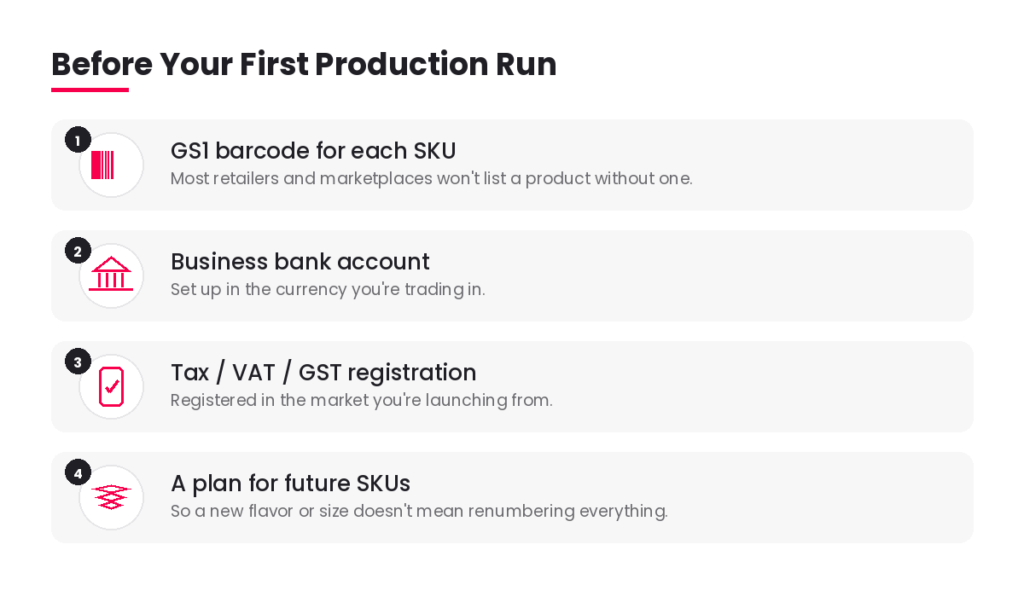
Check your compliance and retail requirements early. Nutritional labels, ingredient declarations, region-specific certification marks, and other mandatory regulatory text take up real space on packaging and can’t be an afterthought — build the layout around them from the start. Alongside the packaging copy itself, four things are worth lining up before your first production run: a GS1 barcode for each SKU (most retailers and major online marketplaces won’t list a product without one), a business bank account in the currency you’re trading in, tax or VAT/GST registration in the market you’re launching from, and a short internal note on how the numbering scheme extends to future SKUs so a new flavor or size doesn’t mean renumbering everything you’ve already printed. Requirements differ by country — the UAE, UK, Australia, Singapore, Canada, and the US each have their own barcode, tax, and labeling rules — so confirm specifics with a local accountant or your GS1 member organization rather than assuming one market’s rules apply everywhere.
Test the physical sample, not just the digital mockup. Colors shift between screen and print, matte and gloss finishes change how a design reads, and a mockup rarely reveals problems a printed sample makes obvious immediately.
Budget for at least one packaging iteration after the first production run. Real customer photos and returns and damage data will tell you things a pre-launch design process can’t, treat packaging as something you refine post-launch, not something you have to get perfect on the first try.
If you’re also comparing branding partners for a specific market, hiring a branding agency for UAE startups follows the same instinct: check what that market actually requires rather than assuming what worked elsewhere carries over.